PBS segment on Mormons and Proposition 8:
This line from Ron Packard got a chuckle: "The [LDS] church has a long tradition of encouraging thinking members to not be afraid to speak up ..."
But, otherwise, I'm gonna forego my usual whinging and admit there's not much to complain about here. Lisa Fahey and Laura Compton? What's not to like? I only hope as many Mormons as possible might watch this segment and then proceed to visit Mormons for Marriage and leave a note there letting those folks know how much they're appreciated.


 |
 |


BYU-Idaho dissolves student political parties
In a bit of odd news coming out of Idaho today ...
"BYU-Idaho is enforcing political neutrality amongst students on campus."
The MountainGoat Report wonders "if the flak the LDS church received, including questions regarding violations of federal tax law, over their involvement in California's Proposition 8 ballot measure hasn't had some effect."
The Rexburg Standard Journal reports that "the administration has given ... encouragement to create ... groups off campus ... These new groups, which could include college students and members of the community, would not be allowed to hold meetings on the BYU-Idaho campus."
Deseret News runs an AP piece that notes:
And now Liberty University has followed suit? Doubly odd.
"BYU-Idaho is enforcing political neutrality amongst students on campus."
The MountainGoat Report wonders "if the flak the LDS church received, including questions regarding violations of federal tax law, over their involvement in California's Proposition 8 ballot measure hasn't had some effect."
The Rexburg Standard Journal reports that "the administration has given ... encouragement to create ... groups off campus ... These new groups, which could include college students and members of the community, would not be allowed to hold meetings on the BYU-Idaho campus."
Deseret News runs an AP piece that notes:
Carri Jenkins, a spokeswoman for Brigham Young University in Provo, said the university's main campus is not disbanding its College Republicans or College Democrats student organizations.Odd. Even wingnut Mormon bloggers are scratching their heads over this one. I'd be interested to hear Kim Clark defend this decision.
"It's not something that's under discussion," Jenkins said.
Michael Johanson, a spokesman at BYU-Hawaii, also said that campus has no plans to dissolve the two groups, either.
And now Liberty University has followed suit? Doubly odd.
The New York Marriage Fund

H/T NG.
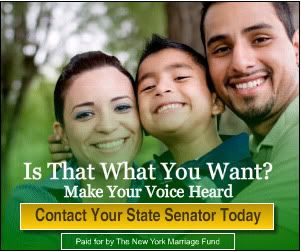
Apparently, The New York Marriage Fund is a NOM project. And apparently their web ads have begun popping up all over the place.
If you live in New York and care about marriage equality, create an account at the NY Senate website and make your opinion heard. The fate of equality in New York currently rests with the Senate. Let the National Organization for Marriage spend their money, but don't let them dominate the debate. h/t kos
And for a chuckle, check out Dennis DiClaudio's post over at Comedy Central's Indecision Forever.
New York Marriage Equality: Astroturfing - Courtesy of the Same Ten (Mormon) People
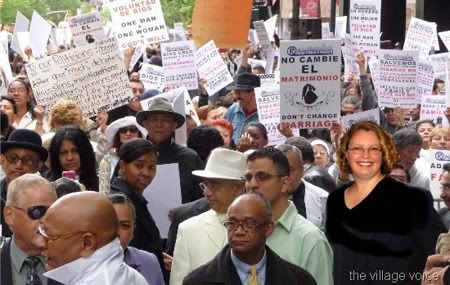
In her report on the New York "pro-marriage" rally, Mormon blogger (and Digital Network Army director) Angela Rockwood (aka Beetle Blogger) suggests that if you are a New Yorker, you'll want to know about these sites:
New Yorkers for Constitutional Freedoms
New Yorkers Family Research Foundation
For once, I agree with Angela: If you're a New Yorker, please take her advice and check out both sites.
I did. Here's what I found:
Shared contact info (NYCF's details on the left, NYFRF's details on the right):
 |  |
Not only did both organizations opt to locate in Spencerport, NY, they also somehow wound up sharing the same fax machine?
Moving on to WHOIS details:
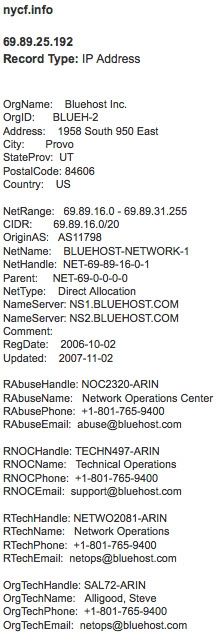 | 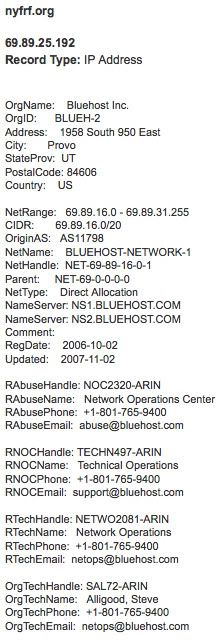 |
Whereas Spencerport, NY is apparently doing some great deals on cheap PO boxes and shared fax lines ... Provo, Utah's bluehost.com must be offering the best deals in the country when it comes to wingnut web hosting.
What does it all mean? I'd suggest it means, that behind the scenes, it's the same ten (generously-funded) people coordinating (online) opposition to marriage equality.
Notice the same lame DNA logo at both the New Yorkers Family Research Foundation and the New Yorkers for Constitutional Freedoms websites?
Notes from a previous campaign (courtesy WikiLeaks):
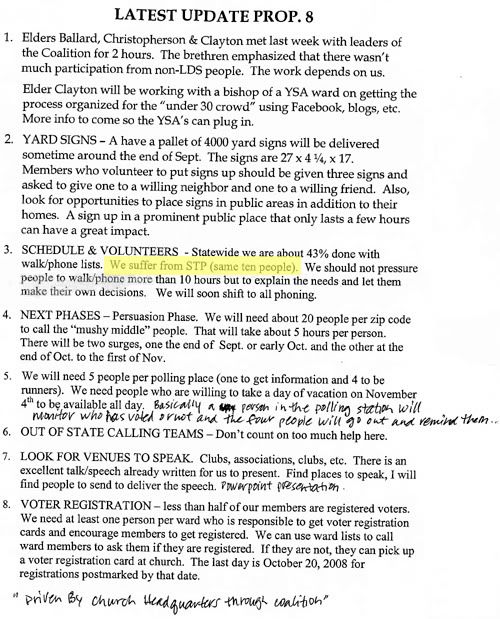
STP. Not an exclusively Mormon problem. We're all suffering on account of the Same Ten (Misguided) People.
If you've got a sec, please drop a comment over at Angela's place.
Thank you, Governor Lynch. Thank you, Amelia.
H/T and thanks to Blue Hampshire for this touching reminder of why we're all here:
As Martin Luther King challenged us:
Because, as a certain New Hampshire poet reminds us, we have promises to keep ...
Because, well, New Hampshire makes six, and we've only just begun:
White lace and promises.
Have a great weekend!
As Martin Luther King challenged us:
“From the prodigious hilltops of New Hampshire, let freedom ring. From the mighty mountains of New York, let freedom ring. From the heightening Alleghenies of Pennsylvania, let freedom ring. But not only that: Let freedom ring from every hill and molehill of Mississippi.”Yes, even from every hill and molehill of Mississippi.
Because, as a certain New Hampshire poet reminds us, we have promises to keep ...
Whose woods these are I think I know.... including this promise:
His house is in the village though;
He will not see me stopping here
To watch his woods fill up with snow.
My little horse must think it queer
To stop without a farmhouse near
Between the woods and frozen lake
The darkest evening of the year.
He gives his harness bells a shake
To ask if there is some mistake.
The only other sound's the sweep
Of easy wind and downy flake.
The woods are lovely, dark and deep.
But I have promises to keep,
And miles to go before I sleep,
And miles to go before I sleep.
"... to all the gay and lesbian kids out there tonight who have been told they are 'less than' by the churches, by the government, by their families ... you are beautiful, wonderful creatures of value ... no matter what anyone tells you, God does love you ... you will have equal rights, federally, across this great nation of ours."You will. Even in Mississippi.
Because, well, New Hampshire makes six, and we've only just begun:
White lace and promises.
Have a great weekend!
Pastor may have lost post over Prop 8
by Dan Aiello
Bay Area Reporter
05/14/2009
The pastor of the Westminster Presbyterian Church in Sacramento was removed from his post by the denomination's regional leadership Monday without explanation. LGBT activists believe his firing, which began in earnest in January, is likely the result of his ordination of three gay parishioners to leadership positions within the congregation and his staunch opposition to Proposition 8.
The decision to remove the Reverend Dr. David Thompson from Westminster was made by a regional administrative commission that did not include a single member of his church's 500 congregants, none of whom were allowed into the closed meeting held at the church May 11. Instead, congregants and approximately 50 members of Sacramento's LGBT and allied community, including many from PFLAG, along with a half dozen pastors from other downtown churches, gathered in a small sanctuary within Westminster's Mission-style compound to pray for justice for Thompson.
Their prayers went unanswered.
(Article continues here)
Bay Area Reporter
05/14/2009
The pastor of the Westminster Presbyterian Church in Sacramento was removed from his post by the denomination's regional leadership Monday without explanation. LGBT activists believe his firing, which began in earnest in January, is likely the result of his ordination of three gay parishioners to leadership positions within the congregation and his staunch opposition to Proposition 8.
The decision to remove the Reverend Dr. David Thompson from Westminster was made by a regional administrative commission that did not include a single member of his church's 500 congregants, none of whom were allowed into the closed meeting held at the church May 11. Instead, congregants and approximately 50 members of Sacramento's LGBT and allied community, including many from PFLAG, along with a half dozen pastors from other downtown churches, gathered in a small sanctuary within Westminster's Mission-style compound to pray for justice for Thompson.
Their prayers went unanswered.
(Article continues here)
NOM and Cornerstone Policy Research Present: "I'm Confused"
I'm confused, too.
Don't YouTube Community Guidelines prohibit speech which demeans a group based on sexual orientation?
What about this NOM/CPR Action ad is NOT demeaning?
YouTube user nhcornerstone originally posted this ad, and it remains available on nhcornerstone's user page.
National Organization for Marriage and Cornerstone Policy Research are responsible for funding and producing this demeaning ad, but YouTube is now responsible for providing a platform for their hate.
I've already complained to YouTube.
If they take down CPR's version of the ad, I'll take down mine.
In the meantime, unlike CPR's version, mine allows comments and ratings.
Feel free to complain about this ad over at CPR's Facebook page.
And kudos to Jeremy for his ongoing reporting on CPR's shenanigans.
Compare and contrast:
UPDATE: Oh, nevermind, I just found the original NOM version ...
2,637 ratings - 47,846 views - 1 lonely star
D'oh. It's already gotten the rough treatment it deserves.
And me and this diary are a waste of space today.
Or, maybe not. The crew over at Pam's House Blend are weighing in with worthy commentary.
About that CPR-A Cornerstone Policy Research New Hampshire "Poll"
I first read about it here.
Anti-marriage equality "Beetle Blogger" Angela Rockwood was joyfully touting the "good news" :
NH PUBLIC: 64% SUPPORT MARRIAGE TO ONLY BE ONE-MAN, ONE-WOMAN
Support that Angela claims was based on this question:
But now I've just returned from reading a local NH columnist's report here, and if he's got his story right, the question asked in that CPR-A poll was this:
So now here's my question: will CPR Action settle this by providing the actual script used in their poll?
Because so far I've found one New Hampshire blogger who describes his "nasty push poll" experience here, and it looks to me as if his recollection of the question matches that reported by our intrepid Telegraph columnist.
And just found another here:
Hey, CPR, release the audio.
I double dog dare you.
Or, better yet, what the heck ...

Comments welcome, but for the purposes of this post, please consider leaving yours at CPR's facebook page.
And if you're feeling extra pesky, why not join the fun over at bb's place?
Otherwise, kick back and enjoy the mellow sounds of G-A-Y:
And we're the ones who're a threat to kids ... unbelievable (NOM got smart and disabled ratings and comments for this one, but I can still flag it for abuse of YouTube community standards, and I have):
Letter to the Editor: New Hampshire Calling - Please Stop!
Anti-marriage equality "Beetle Blogger" Angela Rockwood was joyfully touting the "good news" :
NH PUBLIC: 64% SUPPORT MARRIAGE TO ONLY BE ONE-MAN, ONE-WOMAN
Support that Angela claims was based on this question:
"Do you agree that marriage between one man and one woman should be the only legal definition of marriage in NH?"And then I wandered over to "Good as You" and noticed that they'd taken up the issue of this "bad news" CPR-A poll here.
But now I've just returned from reading a local NH columnist's report here, and if he's got his story right, the question asked in that CPR-A poll was this:
"Do you agree that marriage between only one man and one woman should be legal in New Hampshire?"Which is obviously not the same question (and one that if understood correctly would likely be answered in the affirmative by ALL respondents).
So now here's my question: will CPR Action settle this by providing the actual script used in their poll?
Because so far I've found one New Hampshire blogger who describes his "nasty push poll" experience here, and it looks to me as if his recollection of the question matches that reported by our intrepid Telegraph columnist.
And just found another here:
the "poll" was a robocall from a DC number which launched into a confusingly worded push poll. What is possible is that a lot of people in NH answered "yes" to a question that went something like this: Should marriage between a man and a woman be legal in NH?That sounds about right (and much better than my request to see the script), so ...
Dare them to release the audio of their "poll" questions.
Hey, CPR, release the audio.
I double dog dare you.
Or, better yet, what the heck ...
Comments welcome, but for the purposes of this post, please consider leaving yours at CPR's facebook page.
And if you're feeling extra pesky, why not join the fun over at bb's place?
Otherwise, kick back and enjoy the mellow sounds of G-A-Y:
And we're the ones who're a threat to kids ... unbelievable (NOM got smart and disabled ratings and comments for this one, but I can still flag it for abuse of YouTube community standards, and I have):
Letter to the Editor: New Hampshire Calling - Please Stop!
Heroes vs Zeroes: another NOM FAIL, this time on CNN
If you're put off by Brian Brown's ceiling gazing, hang in there. He finds the camera eventually.
The LDS Church, Proposition 8, and the Federal Law of Charities
by Brian Galle*
In the days before and after the passage of California's "Proposition 8," a ballot initiative barring legal recognition of same-sex marriages in the state, it was widely reported that the LDS Church, together with other religious organizations, played a significant role in supporting the initiative. National attention peaked with a New York Times report detailing some of the church's efforts, which included e-mails to members imploring them to donate money to "Yes on 8" organizations as well as other logistical support for proponents of the measure. Gay rights advocates and others have now called for an investigation of the Church's activities, arguing that they violate federal restrictions on political activities by tax-exempt charities.
This Essay considers the merits of the argument that the Mormon Church's support for Proposition 8 violated federal tax law. I take as given the facts reported by the New York Times and other major news outlets. Although the facts are not really in dispute, much of the underlying law is. There are few clear guidelines governing lobbying by charities. In the end it is impossible to say whether the Church's conduct will have any tax-law repercussions. My conclusion that there is uncertainty, though, stands in contrast with existing claims that the expenditures of the LDS Church and others are clearly unproblematic.
My discussion here is also aimed at revealing some of the weaknesses of the law of charities. In particular, the Proposition 8 episode exposes a serious hole in the fabric of the federal law: the possibility that massive, multi-million dollar lobbying expenditures, large enough to swamp any opposition, may be perfectly legitimate, so long as they are undertaken by a sufficiently gigantic organization. It is hard to see a good justification for a rule that would, in effect, grant political influence only to the largest charities, but that seems to be one plausible interpretation of current law (albeit an interpretation I argue against here). Further, recent events show that the IRS so far has failed to grapple with the most important questions surrounding the rules against lobbying, such as the problem of how to value the use of mailing lists, websites, e-mail, and phone trees—tools that now are central to modern politics.
Part I of the Essay sets out the background rules governing charities. Part II explains how these rules, as interpreted to date, lead to fairly inconclusive results in the Prop 8 scenario, largely because of valuation problems and uncertainty about the extent of permissible activities for large organizations. Part III presses more closely towards a thorough understanding of the political-activity laws, arguing that the two best candidates for the purposes underlying those laws both suggest that the LDS Church's expenditures should be problematic.
I. Federal Limits on "Substantial" Political Activity by Charities
Churches and other forms of charity are generally exempted by § 501(c)(3) of the Tax Code from the federal tax on the income of corporations. Section 170 of the Code also allows individuals who make contributions to those organizations to deduct some or all of their contribution on their federal income tax return. It is this eligibility to receive deductible contributions that distinguishes (c)(3)'s from so-called "noncharitable" nonprofit organizations, many of whom also are exempt from federal corporate income tax. Qualifying as a 501(c)(3) also often results in additional state tax benefits.
In order to obtain the extra goodies that come with (c)(3) status, a would-be charity must abide by a set of additional requirements over and above those faced by other nonprofits. Most pertinently for our purposes, "no substantial part" of a charity's activities can consist of "propaganda, or otherwise attempting, to influence legislation." Similarly, a charity must forfeit its exemption if it carries on one or more "substantial" nonexempt purposes such as running an unrelated for-profit business.
There is no clear law on what comprises a "substantial" amount of lobbying. In the leading cases upholding IRS decisions to revoke (c)(3) status, the offending charity either engaged in pervasive lobbying, or could not achieve any of its ends except through lobbying. Because it was obvious in all of those instances that the lobbying was more than insubstantial, we have little guidance about how to decide closer cases. Conversely, in the leading case in which a court rejected the IRS's determination, less than "5% of the time and effort" of the organization was devoted to lobbying.
The rules for determining what amounts to "substantial" commercial activity are somewhat more clear-cut. The Tax Court, a federal trial court with jurisdiction to decide tax disputes, has held that a charity whose nonexempt expenditures were about 10% of its total revenues was not engaging in a "substantial" amount of commercial activity. That is, if an organization brings in $100,000, it can spend up to $10,000 on noncharitable activities without losing its exemption. Later cases have emphasized that this 10% figure is not an absolute safe harbor, however. It also is uncertain whether the Supreme Court, which first crafted the "substantial" commercial activity language, would read that term to have the same meaning in the context of lobbying activities.
Some charities can escape much of this uncertainty by electing into a more definite set of rules under Tax Code § 501(h). The 501(h) election permits an organization to make lobbying expenditures without fear of penalty so long as the organization stays below its statutory expenditure cap. The cap increases in proportion to the charity's revenues, but maxes out at $1 million no matter the size of the organization. Importantly, churches cannot make a 501(h) election. However, as I will argue, it is possible that the structure of § 501(h) has implications for the proper interpretation of "substantial" even for nonelecting charities.
II. Proposition 8 and the Valuation Problem
How, then, do these rules play out in the context of the Proposition 8 controversy? The reported facts seem not to be in dispute. The LDS Church leadership announced its support for Proposition 8 in a letter that was to be read in every Mormon congregation, in which leaders strongly intimated that church members should donate time and money to supporting Proposition 8. During the weeks leading up to the vote, church officials took part in a satellite broadcast "discussing the LDS Church's doctrine of marriage and describing the church's participation in the Protect Marriage Coalition, which wants voters to approve the initiative." The broadcasters urged viewers to contact "friends, family and fellow-citizens in California" and encourage them to support the initiative. The Church reportedly "tapped every resource, including the church's built-in phone trees, e-mail lists and members' willingness to volunteer and donate money." It also ran a website—preservingmarriage.org, labeled an "official website" of the Church—with content including videos supporting the ban. The Church's support paid off, as both sides estimated that about half of the $40 million spent in support of Prop 8 came from Mormons.
As a threshold matter, there is little doubt that many of these activities constitute "lobbying" as the IRS has interpreted that term. Charities may disseminate "nonpartisan" and "objective" information about pending legislation, but statements that express only one side of a controversial issue do not qualify. It is not clear from reported accounts who made use of the Church's e-mail and phone lists—that is, whether the Church itself made calls and e-mails, or instead shared those lists with the organizations leading the Proposition 8 charge. That, however, probably makes no difference. Providing services for free or at discount to others who are engaged in lobbying is likely itself lobbying; the Treasury has said as much in regulations issued to implement § 501(h), and there is no obvious reason the rule would be different for nonelecting organizations. Otherwise charities could easily escape the lobbying limits by use of a simple shell entity.
The difficult question, then, is whether together the Church's activities are "substantial." Commentators to date have assumed that, because of the vast size of the Mormon Church, its Proposition 8 efforts cannot be substantial. While exact financial information on the Mormon Church is not publicly available, estimates of its annual revenues are usually on the order of hundreds of millions, if not billions, of dollars. Since the Church's direct expenditures were reportedly fairly limited, the Church could likely argue that its spending was well under the 5% or 10% thresholds in existing caselaw.
This analysis rests on two important assumptions, both of them questionable. First, it is possible that the actual value of the Church's contributions is large, perhaps even exceeding the $20 million spent directly by its members. In the case of 501(h)-electing organizations, the IRS would compute the value of the organization's efforts by totaling the costs of preparing the lobbying communications, including a proportion of the organization's salary and other overhead costs, based on the time the charity's staff devoted to lobbying. Considering that the Church's documented communications were relatively modest—a broadcast, a website, and the distribution of e-mail and phone lists—the allocable costs to the Church under this method would also be fairly small. It simply isn't very expensive to send a ten-minute e-mail.
Yet the difficulties with this approach are myriad. For one, it appears to omit entirely the costs of compiling the mail, e-mail and phone lists used to distribute the communication. But most of the costs and value in political communications are precisely located in the task of identifying accurately those who would be most receptive to the message.
Relatedly, a church's communication with its members is likely to carry far more weight than a similar message from an unrelated party to the same group. In commercial terms, the church has an established store of goodwill, which in a market setting would command a high premium. A more economically accurate method of valuing the communication would be the price the charity could obtain for renting out its services (including its endorsement) to an unrelated outsider. In this instance, that figure might have been quite large. While such transactions have been rare among churches, universities, and other charities now commonly contract with private firms to sell their implicit endorsement to members, as with so-called "affinity" credit cards. Those deals might provide at least a baseline for comparison for the value of church political efforts.
We do not know, however, how courts would resolve this valuation dilemma. The 501(h) rules by their terms do not apply to churches, and the holes I have just outlined suggest that their power to persuade by analogy should be limited. Perhaps the most viable approach would be to employ something like the 501(h) valuation rules, but to recognize that they fail to account for a substantial amount of the value added by nonprofit lobbyists. Thus, the 501(h) number alone should not determine whether a charity has exceeded 10% or some other threshold; instead, the court should weigh both the 501(h) total and the other factors I have mentioned. Admittedly, this approach would create a fair deal of uncertainty, but most of the uncertainty would fall on large, established charities, whose vast member lists and accumulated goodwill would be most subject to valuation questions. Those organizations likely have the institutional capacity to consult experts and plan accordingly.
III. Is "Substantiality" a Meaningful Limit for Large Charities?
The second assumption behind commentators' conclusion that the LDS expenditures are unproblematic is that there is no meaningful limit on how high lobbying expenses can rise, so long as they remain approximately 10% of the charity's revenues. The implication is that a sufficiently large entity could spend billions of dollars without violating the prohibition against "substantial" lobbying efforts.
That view seems to strain the plain meaning of "substantial." It is hard to believe that a charity could outspend its opponents by a large margin and still have engaged in insubstantial lobbying. Nor is it clear why charities with large budgets should be free to exert political influence while small charities are condemned to be ineffectual. At best, it seems the statutory language is ambiguous between meaning "substantial" in relation to the size of the organization and "substantial" in an expenditure's effects on political outcomes. Therefore, we likely must consider the purposes behind the lobbying ban in order to interpret its scope.
While Congress has not been explicit about its goals in enacting the limit on lobbying, we might infer its views from the structure of the statute. Notably, § 501(h) caps permissible contributions at $1 million, regardless of the size of the organization. The implication is that some expenditures are too large to be permitted, no matter the size of the organization.
Admittedly, it could be argued in response that § 501(h) is intended to serve as a "safe harbor" provision to provide certainty in an uncertain field, and thus that there should be little negative inference that amounts above the safe harbor are impermissible. But, even if so, the design of the safe harbor still sheds some light on Congress' view about the correct interpretation of § 501(c)(3). If (c)(3) offers an opportunity for massive expenditures by massive organizations, then the § 501(h) safe harbor is useless for just those organizations that are most in need of assurance—those that invest a large sum in lobbying. Either Congress did not believe that such large expenditures were permissible under the "substantial" standard, or it did not want to encourage large expenditures by offering safe harbor to them. Either way, § 501(h) undermines somewhat the unlimited reading of "substantial."
Turning to academic theories, commentators have offered two main justifications for the lobbying limits. For one, the lobbying limits mitigate the impact of wealth on the political process. Charitable contribution deductions are more valuable (and economically more feasible) for high-income taxpayers, so that permitting entities that receive deductible donations to lobby would give disproportionate voice to rich contributors. Second, lobbying restrictions help to preserve charity as a separate sphere from government. When charity is a political player, government has incentives to manipulate the charitable sphere, to capture or blunt charitable influence. Both of these rationales are controversial, but to date they offer the best principled explanations for the current statutory scheme.
The wealth rationale clearly would condemn big spending by big organizations. Indeed, under the wealth rationale one might expect that there should be no permissible lobbying because any amount of lobbying would run the risk of distorting the political process. But perhaps a de minimis exception makes sense in a world in which it may be difficult to distinguish between impermissible lobbying and permissible charitable activity.
It could be argued that the wealth rationale is incoherent in that the Tax Code appears to permit other lobbying expenditures to be deductible, such as some dues paid by corporate members of business leagues, which are in turn permitted to lobby. At best, though, this reduces the second layer of tax on business entities; it does not directly reduce the tax paid by individual shareholders. Thus, shareholders who use their corporation for lobbying purposes generally cannot come out ahead of other nonshareholders. There have been some proposals to permit (c)(3) organizations to lobby using nondeductible funds, but none of these to date has dealt persuasively with the question of how to value the goodwill and economies of scale built up by the charity with deductible dollars.
The separate spheres rationale, too, looks to be inconsistent with a boundless reading of "substantial." The relevant factor under that rationale should be whether or not a charity's activities are important enough to tempt government officials to meddle with the charity's affairs. Expenditures large enough to tip an election are bound to draw attention from governmental actors, regardless of the size of the organization. True, large charities may be more difficult for government to influence, but that might simply increase the size of the temptations, threats, or whatnot the officials offer to the charity.
Conclusion
Under existing precedent, the outcome of any challenge to the LDS Church's intervention in Proposition 8 is uncertain. Most caselaw has looked to the cost, and perhaps time and effort, devoted to lobbying, and compared that to the organization's overall size. By that standard, the Church's vast size likely shields it from any serious threat of revocation. But that method has serious problems. It fails to consider the true economic value of political endorsements by influential organizations with extensive and time-tested lists of phone numbers and e-mail addresses. And more importantly, it neglects the fact that under either of the most persuasive explanations for the very existence of the lobbying limits, it makes no sense to permit multi-million dollar expenditures simply because a charity itself is large.
Even under my proposed methodology, the outcome of any challenge to the Church's exemption is hard to predict. We do not know how the market would value the use of the Church's mailing lists nor do we know the value of the staff time and other costs the Church invested. Perhaps these sums are modest, even in absolute terms. My point here is only that if these figures prove to be large—several million dollars, say—then there ought to be a serious question whether revocation is appropriate. The fact that several million dollars is a tiny fraction of the Church's budget should not by itself render the expenditure permissible.
* Brian is a Visiting Associate Professor at Georgetown University Law Center and Assistant Professor, Florida State University School of Law
First published in the Northwestern University Law Review Colloquy as 103 Nw. U. L. Rev. Colloquy 370 (2009), http://www.law.northwestern.edu/lawreview/colloquy/2009/10/
Republished with permission
[download PDF version]
In the days before and after the passage of California's "Proposition 8," a ballot initiative barring legal recognition of same-sex marriages in the state, it was widely reported that the LDS Church, together with other religious organizations, played a significant role in supporting the initiative. National attention peaked with a New York Times report detailing some of the church's efforts, which included e-mails to members imploring them to donate money to "Yes on 8" organizations as well as other logistical support for proponents of the measure. Gay rights advocates and others have now called for an investigation of the Church's activities, arguing that they violate federal restrictions on political activities by tax-exempt charities.
This Essay considers the merits of the argument that the Mormon Church's support for Proposition 8 violated federal tax law. I take as given the facts reported by the New York Times and other major news outlets. Although the facts are not really in dispute, much of the underlying law is. There are few clear guidelines governing lobbying by charities. In the end it is impossible to say whether the Church's conduct will have any tax-law repercussions. My conclusion that there is uncertainty, though, stands in contrast with existing claims that the expenditures of the LDS Church and others are clearly unproblematic.
My discussion here is also aimed at revealing some of the weaknesses of the law of charities. In particular, the Proposition 8 episode exposes a serious hole in the fabric of the federal law: the possibility that massive, multi-million dollar lobbying expenditures, large enough to swamp any opposition, may be perfectly legitimate, so long as they are undertaken by a sufficiently gigantic organization. It is hard to see a good justification for a rule that would, in effect, grant political influence only to the largest charities, but that seems to be one plausible interpretation of current law (albeit an interpretation I argue against here). Further, recent events show that the IRS so far has failed to grapple with the most important questions surrounding the rules against lobbying, such as the problem of how to value the use of mailing lists, websites, e-mail, and phone trees—tools that now are central to modern politics.
Part I of the Essay sets out the background rules governing charities. Part II explains how these rules, as interpreted to date, lead to fairly inconclusive results in the Prop 8 scenario, largely because of valuation problems and uncertainty about the extent of permissible activities for large organizations. Part III presses more closely towards a thorough understanding of the political-activity laws, arguing that the two best candidates for the purposes underlying those laws both suggest that the LDS Church's expenditures should be problematic.
I. Federal Limits on "Substantial" Political Activity by Charities
Churches and other forms of charity are generally exempted by § 501(c)(3) of the Tax Code from the federal tax on the income of corporations. Section 170 of the Code also allows individuals who make contributions to those organizations to deduct some or all of their contribution on their federal income tax return. It is this eligibility to receive deductible contributions that distinguishes (c)(3)'s from so-called "noncharitable" nonprofit organizations, many of whom also are exempt from federal corporate income tax. Qualifying as a 501(c)(3) also often results in additional state tax benefits.
In order to obtain the extra goodies that come with (c)(3) status, a would-be charity must abide by a set of additional requirements over and above those faced by other nonprofits. Most pertinently for our purposes, "no substantial part" of a charity's activities can consist of "propaganda, or otherwise attempting, to influence legislation." Similarly, a charity must forfeit its exemption if it carries on one or more "substantial" nonexempt purposes such as running an unrelated for-profit business.
There is no clear law on what comprises a "substantial" amount of lobbying. In the leading cases upholding IRS decisions to revoke (c)(3) status, the offending charity either engaged in pervasive lobbying, or could not achieve any of its ends except through lobbying. Because it was obvious in all of those instances that the lobbying was more than insubstantial, we have little guidance about how to decide closer cases. Conversely, in the leading case in which a court rejected the IRS's determination, less than "5% of the time and effort" of the organization was devoted to lobbying.
The rules for determining what amounts to "substantial" commercial activity are somewhat more clear-cut. The Tax Court, a federal trial court with jurisdiction to decide tax disputes, has held that a charity whose nonexempt expenditures were about 10% of its total revenues was not engaging in a "substantial" amount of commercial activity. That is, if an organization brings in $100,000, it can spend up to $10,000 on noncharitable activities without losing its exemption. Later cases have emphasized that this 10% figure is not an absolute safe harbor, however. It also is uncertain whether the Supreme Court, which first crafted the "substantial" commercial activity language, would read that term to have the same meaning in the context of lobbying activities.
Some charities can escape much of this uncertainty by electing into a more definite set of rules under Tax Code § 501(h). The 501(h) election permits an organization to make lobbying expenditures without fear of penalty so long as the organization stays below its statutory expenditure cap. The cap increases in proportion to the charity's revenues, but maxes out at $1 million no matter the size of the organization. Importantly, churches cannot make a 501(h) election. However, as I will argue, it is possible that the structure of § 501(h) has implications for the proper interpretation of "substantial" even for nonelecting charities.
II. Proposition 8 and the Valuation Problem
How, then, do these rules play out in the context of the Proposition 8 controversy? The reported facts seem not to be in dispute. The LDS Church leadership announced its support for Proposition 8 in a letter that was to be read in every Mormon congregation, in which leaders strongly intimated that church members should donate time and money to supporting Proposition 8. During the weeks leading up to the vote, church officials took part in a satellite broadcast "discussing the LDS Church's doctrine of marriage and describing the church's participation in the Protect Marriage Coalition, which wants voters to approve the initiative." The broadcasters urged viewers to contact "friends, family and fellow-citizens in California" and encourage them to support the initiative. The Church reportedly "tapped every resource, including the church's built-in phone trees, e-mail lists and members' willingness to volunteer and donate money." It also ran a website—preservingmarriage.org, labeled an "official website" of the Church—with content including videos supporting the ban. The Church's support paid off, as both sides estimated that about half of the $40 million spent in support of Prop 8 came from Mormons.
As a threshold matter, there is little doubt that many of these activities constitute "lobbying" as the IRS has interpreted that term. Charities may disseminate "nonpartisan" and "objective" information about pending legislation, but statements that express only one side of a controversial issue do not qualify. It is not clear from reported accounts who made use of the Church's e-mail and phone lists—that is, whether the Church itself made calls and e-mails, or instead shared those lists with the organizations leading the Proposition 8 charge. That, however, probably makes no difference. Providing services for free or at discount to others who are engaged in lobbying is likely itself lobbying; the Treasury has said as much in regulations issued to implement § 501(h), and there is no obvious reason the rule would be different for nonelecting organizations. Otherwise charities could easily escape the lobbying limits by use of a simple shell entity.
The difficult question, then, is whether together the Church's activities are "substantial." Commentators to date have assumed that, because of the vast size of the Mormon Church, its Proposition 8 efforts cannot be substantial. While exact financial information on the Mormon Church is not publicly available, estimates of its annual revenues are usually on the order of hundreds of millions, if not billions, of dollars. Since the Church's direct expenditures were reportedly fairly limited, the Church could likely argue that its spending was well under the 5% or 10% thresholds in existing caselaw.
This analysis rests on two important assumptions, both of them questionable. First, it is possible that the actual value of the Church's contributions is large, perhaps even exceeding the $20 million spent directly by its members. In the case of 501(h)-electing organizations, the IRS would compute the value of the organization's efforts by totaling the costs of preparing the lobbying communications, including a proportion of the organization's salary and other overhead costs, based on the time the charity's staff devoted to lobbying. Considering that the Church's documented communications were relatively modest—a broadcast, a website, and the distribution of e-mail and phone lists—the allocable costs to the Church under this method would also be fairly small. It simply isn't very expensive to send a ten-minute e-mail.
Yet the difficulties with this approach are myriad. For one, it appears to omit entirely the costs of compiling the mail, e-mail and phone lists used to distribute the communication. But most of the costs and value in political communications are precisely located in the task of identifying accurately those who would be most receptive to the message.
Relatedly, a church's communication with its members is likely to carry far more weight than a similar message from an unrelated party to the same group. In commercial terms, the church has an established store of goodwill, which in a market setting would command a high premium. A more economically accurate method of valuing the communication would be the price the charity could obtain for renting out its services (including its endorsement) to an unrelated outsider. In this instance, that figure might have been quite large. While such transactions have been rare among churches, universities, and other charities now commonly contract with private firms to sell their implicit endorsement to members, as with so-called "affinity" credit cards. Those deals might provide at least a baseline for comparison for the value of church political efforts.
We do not know, however, how courts would resolve this valuation dilemma. The 501(h) rules by their terms do not apply to churches, and the holes I have just outlined suggest that their power to persuade by analogy should be limited. Perhaps the most viable approach would be to employ something like the 501(h) valuation rules, but to recognize that they fail to account for a substantial amount of the value added by nonprofit lobbyists. Thus, the 501(h) number alone should not determine whether a charity has exceeded 10% or some other threshold; instead, the court should weigh both the 501(h) total and the other factors I have mentioned. Admittedly, this approach would create a fair deal of uncertainty, but most of the uncertainty would fall on large, established charities, whose vast member lists and accumulated goodwill would be most subject to valuation questions. Those organizations likely have the institutional capacity to consult experts and plan accordingly.
III. Is "Substantiality" a Meaningful Limit for Large Charities?
The second assumption behind commentators' conclusion that the LDS expenditures are unproblematic is that there is no meaningful limit on how high lobbying expenses can rise, so long as they remain approximately 10% of the charity's revenues. The implication is that a sufficiently large entity could spend billions of dollars without violating the prohibition against "substantial" lobbying efforts.
That view seems to strain the plain meaning of "substantial." It is hard to believe that a charity could outspend its opponents by a large margin and still have engaged in insubstantial lobbying. Nor is it clear why charities with large budgets should be free to exert political influence while small charities are condemned to be ineffectual. At best, it seems the statutory language is ambiguous between meaning "substantial" in relation to the size of the organization and "substantial" in an expenditure's effects on political outcomes. Therefore, we likely must consider the purposes behind the lobbying ban in order to interpret its scope.
While Congress has not been explicit about its goals in enacting the limit on lobbying, we might infer its views from the structure of the statute. Notably, § 501(h) caps permissible contributions at $1 million, regardless of the size of the organization. The implication is that some expenditures are too large to be permitted, no matter the size of the organization.
Admittedly, it could be argued in response that § 501(h) is intended to serve as a "safe harbor" provision to provide certainty in an uncertain field, and thus that there should be little negative inference that amounts above the safe harbor are impermissible. But, even if so, the design of the safe harbor still sheds some light on Congress' view about the correct interpretation of § 501(c)(3). If (c)(3) offers an opportunity for massive expenditures by massive organizations, then the § 501(h) safe harbor is useless for just those organizations that are most in need of assurance—those that invest a large sum in lobbying. Either Congress did not believe that such large expenditures were permissible under the "substantial" standard, or it did not want to encourage large expenditures by offering safe harbor to them. Either way, § 501(h) undermines somewhat the unlimited reading of "substantial."
Turning to academic theories, commentators have offered two main justifications for the lobbying limits. For one, the lobbying limits mitigate the impact of wealth on the political process. Charitable contribution deductions are more valuable (and economically more feasible) for high-income taxpayers, so that permitting entities that receive deductible donations to lobby would give disproportionate voice to rich contributors. Second, lobbying restrictions help to preserve charity as a separate sphere from government. When charity is a political player, government has incentives to manipulate the charitable sphere, to capture or blunt charitable influence. Both of these rationales are controversial, but to date they offer the best principled explanations for the current statutory scheme.
The wealth rationale clearly would condemn big spending by big organizations. Indeed, under the wealth rationale one might expect that there should be no permissible lobbying because any amount of lobbying would run the risk of distorting the political process. But perhaps a de minimis exception makes sense in a world in which it may be difficult to distinguish between impermissible lobbying and permissible charitable activity.
It could be argued that the wealth rationale is incoherent in that the Tax Code appears to permit other lobbying expenditures to be deductible, such as some dues paid by corporate members of business leagues, which are in turn permitted to lobby. At best, though, this reduces the second layer of tax on business entities; it does not directly reduce the tax paid by individual shareholders. Thus, shareholders who use their corporation for lobbying purposes generally cannot come out ahead of other nonshareholders. There have been some proposals to permit (c)(3) organizations to lobby using nondeductible funds, but none of these to date has dealt persuasively with the question of how to value the goodwill and economies of scale built up by the charity with deductible dollars.
The separate spheres rationale, too, looks to be inconsistent with a boundless reading of "substantial." The relevant factor under that rationale should be whether or not a charity's activities are important enough to tempt government officials to meddle with the charity's affairs. Expenditures large enough to tip an election are bound to draw attention from governmental actors, regardless of the size of the organization. True, large charities may be more difficult for government to influence, but that might simply increase the size of the temptations, threats, or whatnot the officials offer to the charity.
Conclusion
Under existing precedent, the outcome of any challenge to the LDS Church's intervention in Proposition 8 is uncertain. Most caselaw has looked to the cost, and perhaps time and effort, devoted to lobbying, and compared that to the organization's overall size. By that standard, the Church's vast size likely shields it from any serious threat of revocation. But that method has serious problems. It fails to consider the true economic value of political endorsements by influential organizations with extensive and time-tested lists of phone numbers and e-mail addresses. And more importantly, it neglects the fact that under either of the most persuasive explanations for the very existence of the lobbying limits, it makes no sense to permit multi-million dollar expenditures simply because a charity itself is large.
Even under my proposed methodology, the outcome of any challenge to the Church's exemption is hard to predict. We do not know how the market would value the use of the Church's mailing lists nor do we know the value of the staff time and other costs the Church invested. Perhaps these sums are modest, even in absolute terms. My point here is only that if these figures prove to be large—several million dollars, say—then there ought to be a serious question whether revocation is appropriate. The fact that several million dollars is a tiny fraction of the Church's budget should not by itself render the expenditure permissible.
* Brian is a Visiting Associate Professor at Georgetown University Law Center and Assistant Professor, Florida State University School of Law
First published in the Northwestern University Law Review Colloquy as 103 Nw. U. L. Rev. Colloquy 370 (2009), http://www.law.northwestern.edu/lawreview/colloquy/2009/10/
Republished with permission
[download PDF version]
Outrage: The Movie
Interview with director Kirby Dick:
The trailer:
Doug McKelway's Outrageous Interview with Mike Rogers:
More McKelway:
The trailer:
Doug McKelway's Outrageous Interview with Mike Rogers:
More McKelway:
Note to my Mormon friends at UFI, NOM and the Digital Network Army (DNA)
"No army can withstand the strength of an idea whose time has come." (Victor Hugo)Maine makes 5.
Like a polluted swamp, anti-gay bigotry is likely to get thicker and more toxic as it dries up. (Hendrik Hertzberg)And here's what the swamp is looking like these days.
Because the LDS, UFI, DNA and NOM are all facing the same problem: STP (i.e., they've been reduced to relying on the same ten people, who're now working overtime to create the impression that what they're representing are grassroots movements and not some top-down astroturfing operation run by LDS Public Affairs).
Marie Osmond Talks About Her Daughter's Civil Rights
Disclosure: I had the privilege of making a chocolate mint oreo shake for Marie
way back when during my student days at BYU. Before pulling away from Stevenette's
drive-thru window, she met my gaze and thanked me for piling on the crumbles.
The connection Marie and I made that day disqualifies me from dispassionately
blogging about her latest courageous comments, and so I'll be leaving it to others
to provide the objective commentary that I'm incapable of when it comes to
Mormondom's classiest lady.
From the archives: You already know everything there is to know about same-sex marriage
by Robert Latham
That’s right, you already know everything there is to know. There are no surprises anymore, so each side of the battle is really just waiting for the other to lose steam, change its mind, or age out and die.
In case you think I’m trying to avoid engaging the arguments, here are the major talking points from both camps:
Arguments against same-sex marriage:
(1) Marriage is an institution defined historically as the union between one man and one woman.
(2) Children are optimally cared for in homes with a mother and a father.
(3) The purpose of marriage is procreation and societal stability.
(4) Same-sex marriage is an untested and dangerous social experiment.
(5) Same-sex marriage is part of a slippery slope to universal depravity.
(6) Gay relationships themselves are immoral.
Arguments against the arguments against same-sex marriage:
(1) You don’t have a bit of evidence for any of that, and
(2) Please, quit being a jerk.
See? No surprises.
Now, I want to confess that I’m very gay, and the rest of this article will be biased appropriately. I also want to confess that I have no idea what marriage is. That’s ok, though, because if we had enough time and wine, I’m pretty sure you’ll discover that you don’t either. This should not prove any impediment to the conversation.
You might notice that the arguments against same-sex marriage seem to be more numerous than the arguments for it. There are two reasons for that: first, most of them aren’t actually arguments against; and second, arguments don’t get you very far in this sort of thing anyway.
Let’s start with that first part. Even though I put six things on the list, most of them aren’t arguments against same-sex marriage at all. Argument (1), for example, isn’t against same-sex marriage--it’s for the strengthening of hetero-sex marriages. Same with (2). Argument (3) is similar, except that given the now-public knowledge that men and women don’t have to be married or even in the same room to conceive a baby, it actually argues for extending marriage to anybody willing to raise a kid in tandem.
Two of them are just smoke screen distractions. Argument (4) has always sounded silly to me, because everything new is potentially dangerous, and same-sex marriage isn’t untested anymore; and Argument (5) is popular among juridical thinkers, but is equally a non-starter in the real world. Really it is: why can 5th cousins but not 4th cousins be married? Because we drew the line there. Why will allowing gays to marry not automatically allow people to marry patio furniture? Because we’ll draw the line there as well. Those who find themselves in a committed relationship with a wicker bistro set will have their own fight to fight. I will happily stand behind their right to love whatever they love. They, however, will be responsible for figuring out the tax implications of their blessed union.
That brings us to Argument (6): Gay relationships are themselves immoral. What can you even say to that? Nothing. That’s when you stop the debate and see if the person wants to grab dinner one night instead. Then you move in down the street a few years later, go shopping with them, watch their dog while they’re out of town, invite them over for Super Bowl parties, call them to gossip, swap turns carpooling the kids to school, and just live. It might take five or ten years, but they’ll figure it out, without you ever saying a word.
The nice thing about the “against same-sex marriage” list of arguments is that it isn’t getting any longer. They’ve had thousands of years to tell us why we’re broken, and about forty years to figure out why we can’t get married (the first American cases were in 1971, according to HRC). Based on what I’ve been hearing for the past 27 years of my own life, it sounds like they’ve run out of new ideas.
On the other hand, every committed same-sex couple is another argument for same-sex marriage. Every kid who comes out is another reason to quit being a jerk and let him dream of white picket fences and a family and love and all the stuff that other kids think they’ll have before they learn how the world really works.
I’m highly optimistic that over the next ten years we won’t need arguments anymore. There is no need to debate what you can plainly see: that it’s love that makes a family, and the energy and breath we waste fighting over who should be a family could be much better spent supporting and encouraging the families that continue to exist whether we legally recognize them or not. It doesn’t require even a minute of legal research, or a page of historical reference. It needs neither clever twists of equality doctrine nor the due process guarantee. To see that same-sex marriage should not be denied any longer takes only a single ounce of kindness.
--
Submitted by Robert Latham to Res Gestae: The Student Newspaper of the University of Michigan Law School
That’s right, you already know everything there is to know. There are no surprises anymore, so each side of the battle is really just waiting for the other to lose steam, change its mind, or age out and die.
In case you think I’m trying to avoid engaging the arguments, here are the major talking points from both camps:
Arguments against same-sex marriage:
(1) Marriage is an institution defined historically as the union between one man and one woman.
(2) Children are optimally cared for in homes with a mother and a father.
(3) The purpose of marriage is procreation and societal stability.
(4) Same-sex marriage is an untested and dangerous social experiment.
(5) Same-sex marriage is part of a slippery slope to universal depravity.
(6) Gay relationships themselves are immoral.
Arguments against the arguments against same-sex marriage:
(1) You don’t have a bit of evidence for any of that, and
(2) Please, quit being a jerk.
See? No surprises.
Now, I want to confess that I’m very gay, and the rest of this article will be biased appropriately. I also want to confess that I have no idea what marriage is. That’s ok, though, because if we had enough time and wine, I’m pretty sure you’ll discover that you don’t either. This should not prove any impediment to the conversation.
You might notice that the arguments against same-sex marriage seem to be more numerous than the arguments for it. There are two reasons for that: first, most of them aren’t actually arguments against; and second, arguments don’t get you very far in this sort of thing anyway.
Let’s start with that first part. Even though I put six things on the list, most of them aren’t arguments against same-sex marriage at all. Argument (1), for example, isn’t against same-sex marriage--it’s for the strengthening of hetero-sex marriages. Same with (2). Argument (3) is similar, except that given the now-public knowledge that men and women don’t have to be married or even in the same room to conceive a baby, it actually argues for extending marriage to anybody willing to raise a kid in tandem.
Two of them are just smoke screen distractions. Argument (4) has always sounded silly to me, because everything new is potentially dangerous, and same-sex marriage isn’t untested anymore; and Argument (5) is popular among juridical thinkers, but is equally a non-starter in the real world. Really it is: why can 5th cousins but not 4th cousins be married? Because we drew the line there. Why will allowing gays to marry not automatically allow people to marry patio furniture? Because we’ll draw the line there as well. Those who find themselves in a committed relationship with a wicker bistro set will have their own fight to fight. I will happily stand behind their right to love whatever they love. They, however, will be responsible for figuring out the tax implications of their blessed union.
That brings us to Argument (6): Gay relationships are themselves immoral. What can you even say to that? Nothing. That’s when you stop the debate and see if the person wants to grab dinner one night instead. Then you move in down the street a few years later, go shopping with them, watch their dog while they’re out of town, invite them over for Super Bowl parties, call them to gossip, swap turns carpooling the kids to school, and just live. It might take five or ten years, but they’ll figure it out, without you ever saying a word.
The nice thing about the “against same-sex marriage” list of arguments is that it isn’t getting any longer. They’ve had thousands of years to tell us why we’re broken, and about forty years to figure out why we can’t get married (the first American cases were in 1971, according to HRC). Based on what I’ve been hearing for the past 27 years of my own life, it sounds like they’ve run out of new ideas.
On the other hand, every committed same-sex couple is another argument for same-sex marriage. Every kid who comes out is another reason to quit being a jerk and let him dream of white picket fences and a family and love and all the stuff that other kids think they’ll have before they learn how the world really works.
I’m highly optimistic that over the next ten years we won’t need arguments anymore. There is no need to debate what you can plainly see: that it’s love that makes a family, and the energy and breath we waste fighting over who should be a family could be much better spent supporting and encouraging the families that continue to exist whether we legally recognize them or not. It doesn’t require even a minute of legal research, or a page of historical reference. It needs neither clever twists of equality doctrine nor the due process guarantee. To see that same-sex marriage should not be denied any longer takes only a single ounce of kindness.
--
Submitted by Robert Latham to Res Gestae: The Student Newspaper of the University of Michigan Law School
"No Offense" but the latest NOM ad barely rates a mention
Yawn.
As I mentioned previously, I'm no fan of beauty pageants and take a dim view of anyone associated with their production (as a contestant, judge or in any other role). So, when it comes to issues as important as marriage and civil equality for all families, the last people I want to hear from are the likes of Ms. Prejean or Mr. Hilton (aka Mario Lavandeira), no matter what side they might claim to represent. Whether it's his condemnation of discrimination or her defense of religious principle, both are tainted by association with the degrading spectacle that is The Miss USA Pageant.
And now NOM are spending money to draw further attention to the debased "debate" between these two purveyors of trash culture?
What a waste.
Subscribe to:
Posts (Atom)
SUBSCRIBE | FOLLOW



 Posts
All Comments
Posts
All Comments


