Note: West Ridge Academy is licensed by the State of Utah, and their license is up for renewal this month. When you're done reading Eric's story below, please e-mail the licensor, Bonnie Stuver (BSTUVER@utah.gov), at the Utah Department of Human Services, Office of Licensing.
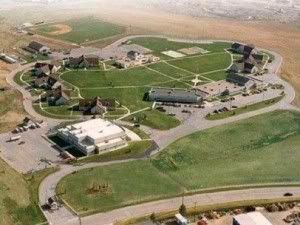
Update: Apparently emails to Bonnie are bouncing. Try this one: ldustman@utah.govBy Eric NorwoodRepublished with author's permissionFurther info at Mormon Gulag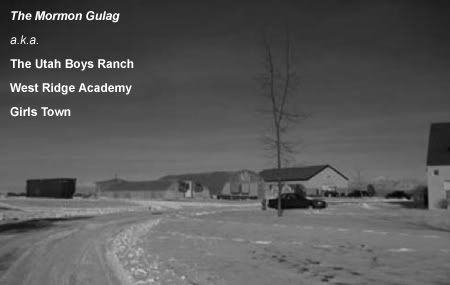 This story is about Eric Norwood's personal experiences at a place called The Utah Boys Ranch, which models itself as a "tough-love" prep-school, but while Eric was there, he witnessed some unbelievable atrocities. It is a Mormon-funded and staffed facility, and religious indoctrination is a fundamental aspect of the school. There was sexual, physical, and emotional abuse, suicide, staff corruption, and escape. A major Utah political figure, Senator Chris Buttars, was the executive director while Eric was there.
This is Eric's story: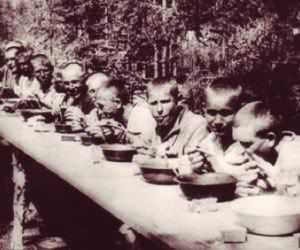
His filthy digit tasted like rust and fish. "I can hurt you without leaving any marks," Brent growled as I writhed in agony on the ground. I struggled for breath as he mounted my back, put his finger in my mouth, and pulled back on my cheek, fish-hooking me. The pain was incredible. I tried to beg him to stop, but the words would not come.
After he finished beating and bludgeoning submissiveness into me, he pulled me up by the rope that was lassoed around my waist. The wool army blanket I had fashioned as a skirt had shifted askew and I stood there in my boxers bleeding from my nose, humiliated.
My green Utah Boys Ranch t-shirt had been ridiculously stretched out and looked more like a low cut blouse. I loosened the noose around my waist and pulled the itchy blanket through the loop and folded it over so it looked like a brown bath towel secured by a belt. He wasn't satisfied, he wanted more. I just wanted out of this classroom. I started to think about how I got here.
The Utah Boys Ranch appears to be a kind of tough-love school with a Christian-esque undertow. My parents thought as much when they employed its services in hopes of corralling their spiritually wayward son.
Being kidnapped was probably the last thing I was worried about at 15 years old. I was staying at my grandma's house that fateful night. My step-dad and I had been at war since I had refused to go to seminary, a church service for Mormon kids in high school that began at the ungodly hour of six in the morning.
I loathed early morning seminary more than the three hours of my Sunday regular LDS church service consumed, or the three hours on Wednesday nights. My opposition, paired with my step-dad's religious fanaticism, resulted in being grounded almost to the point of indentured servitude. Grandma's house was my sanctuary. Ironically, when I looked up at the clock that next morning - as two imposing silhouettes entered the house my mom grew up in - it was five minutes to 6 a.m. on Valentine's Day.
I was camped out on the sofa bed in the TV room with a plate of leftover lasagna from the fridge. It was half eaten and a Roseanne re-run was playing when they first walked in. They looked around as if they had been told where to go, but hadn't quite envisioned it right. They looked to their left, saw the terrified eyes of a 15-year-old, and pounced. They shoved clothes and shoes on me and I was gone before I was able to think about which way I should run. They told me very little. Their first names were Paul and Barry.
Barry was a white guy, a big mother. At least 6'5", and I would not be surprised to hear that he weighed more than 300 pounds, but he was not fat. Paul was shorter and had a darker complexion. He was big too, and meaner than Barry. He turned to me when we first got into their white mid-sized rental car and said, "You have a choice. You can be cool and get on an airplane with us and be there in a couple of hours, or you can sit back there with handcuffs on for the next 12 hours. Non-stop."
"Where are we going?" I asked, still in shock.
"Utah," Barry answered casually from the passenger seat, without turning his head. "We are from the Utah Boys Ranch, Eric, and your parents have asked us to take you back with us."
"What?" My head was spinning. I felt like I was going to throw up. There is no way that this was happening. My mom would never allow this. Utah? What the hell is a Boys Ranch? I couldn't breathe.
"I guess we're driving," Paul said odiously.
I knew the child-lock would be on and as I saw the familiar houses of my grandmother's street pass by, I started to roll down the window. We weren't going fast enough for them to notice yet and the warm Agoura Hills climate didn't tip them off. I rolled it down enough to fit my arm out and open the door from the outside when Paul paused at the stop sign at the bottom of the hill, looked back at me, and stopped the car.
He shoved the gear into park and pulled handcuffs out of somewhere and told me to give him my wrists. I sat there cuffed for a moment when I realized that I really would die from this feeling in my chest - a physical manifestation of angst. My heart was beating furiously, and I knew that I couldn't last 12 hours.
"You can take me on a plane. I'll be cool."
"Now that's more like it," Barry said kindly. "My wife will be happy."
The first person I met in Utah was Senator
Chris Buttars. I had no idea who he was until that point.
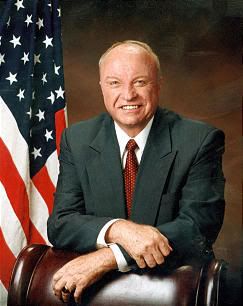
All I knew was that he was to be feared, and I was scared to death of him from the moment I first saw him.
"Sit down," he squawked in a loud, high pitched, galling voice that sounded like a cross between a buzzard and an old cowboy. He continued to make it very clear that I was at his mercy. He told me who he was - politically - and the influence he had. If I ever wanted to leave I was to do what he said. "How old are you?"
"Fifteen," I mumbled.
"Three years might not be enough for you. I can have a judge order you to be here until you are 21," he croaked. With that he sent me off to be "changed and put on work crew."
I was led down a long hall of doors with nameplates. I had no clue what kind of place this was. I didn't see any cows or horses...no sign of what I thought a "ranch" would resemble. Paul took me into a small room that was no bigger than a broom closet, which was stacked to the ceiling with three colors of cloth, blue, green and brown. There were green t-shirts, blue t-shirts, and blue jeans.
There were also brown army wool blankets, and I remember thinking that I didn't want to sleep under such a coarse covering before I was told to "put it on." I was told to wrap a thick, itchy blanket around my waist like a towel and wear it like a dress.
I was then given a "leash" made of climbing rope and what I think was a square knot to tie around my waist.
I had never imagined being tethered and walked like a dog, but here I was, being walked like a dog towards a cluster of about 12 other boys. They were lined up facing a wall while two large men in red sweatshirts watched them from a couple of chairs off to the side.
Some of the boys had camouflage pants on, a few others wore dresses. I wondered how long I was to be in this blanket dress. I was later told that it was so I wouldn't run away - and they were right - I literally could not run in this humiliating getup. I could barely get a full stride walking.
That's when I saw Brent - or 'Captain America,' as he was called disparagingly - for the first time. My leash was handed off to him, but he told me to wrap it around my waist and go join the group of young men who were standing with their noses touching the wall, all spread out about arms length from each other.
I turned to the boy who was standing to my right and asked him how long he had been here, but before I could get my question all the way out, my forehead careened into the carpeted wall in front of me. A sharp pain stabbed the back of my head, and suddenly bad breath filled my nostrils. "Are you talking on my work crew, boy?" a red-shirted man screamed at me.
My head was ringing. I was still trying to piece together what had just happened when I looked behind me and massaged the pain in my head. Suddenly my legs fell out from underneath me and I was on my back.
He had just slammed my forehead into the wall, and now he had put his foot behind mine and pushed me, sending me to the floor flat on my back.
He stood over me and bawled, "Don't look at me. Don't look around. Don't you MOVE without permission! You don't do anything without permission! If you talk, I think you are talking about running away, and I will restrain you. Do you understand?" I nodded. I knew then that I had to get out of this place. I wasn't going to last here.
It was only my second week on work crew when Neil Westwood refused to turn his back to Brent and place his nose on the wall, which is what the command "face the wall" plainly meant. It was a Mexican standoff for a few moments. Stunningly it seemed like Brent was going to let Neil get his way. I had never seen an older boy in a pissing contest with a staff member before. The younger kids refused commands, but they were always quickly thumped into docility.
Neil was a big kid, a lot bigger than me - probably 230 pounds or so, and over six-feet tall, but dispelled any image of toughness with his glasses, disproportionately small arms, and frizzy hairdo. Neil was as obnoxious as he was an easy target, but I still can't believe that no one reacted when Brent stood up in a flash of rage and chucked a full, unopened gallon of milk at Neil's face from about five feet away, crumbling him to a pitiful puddle of tears, blood, and non-fat milk.
The work crew was depraved. When they didn't have us facing the wall for hours at a time we were digging ditches with spoons, only to fill them back in again.
We made huge piles of heavy rocks taken from the field, the field that both surrounded and contained us, only to be told to move the massive mound to another location. They worked us in ways redolent of Stalin's gulags.
There was an agonizing week of all-day sod laying - with bits of mud and grass sticking to the inside of my wool dress - in preparation for some ceremony the work crew boys weren't privy to. The Scarecrow Festival was even worse. We worked for weeks from eight in the morning till eight at night in preparation and to take down that contrived fall carnival/ fundraiser. Boys wished for death. There was also a dry-cleaning service that they operated somewhere in town, which was supposedly much better than any job on campus - even kitchen duty.
Getting off from work crew meant school during the day, and considerably less work. Some sadist there created a t-shirt caste system that involved wearing either a blue t-shirt or green t-shirt. "Blue shirts" could talk, receive letters (which were opened and read first), talk to their parents, and possibly go off campus.
"Green shirts" were allowed into school, but that was about it. No speaking, sitting, or anything but working or reading LDS literature. A "green shirt" was forced to read the Book of Mormon, in particular the first 22 chapters. We were interviewed by one of the four full-time Mormon missionaries that worked there and had to paraphrase all of "First Nephi" before receiving a blue t-shirt. What good derives from reading the Book of Mormon under duress is anyone's guess, but I did it. I had to.

I had to go to church and seminary too.
It turns out that any form of decadence - smoking a little grass, telling your math teacher to sit on it, being gay or bi-curious, sexually assaulting a family member or young girl - is curable by a little hard work, tough love, and Mormon doctrine. Boys with "sexual issues" are housed together in what could only be some cruel showing of satire.
They were constantly being caught jerking each other off onto each other, or, more tragically, assaulting younger boys. Whatever it was, they would be shoved into blankets and thrown on work crew. On Tuesday night they would meet with all the boys with sexual issues and provide remedies like
IcyHot on the penis to stifle homosexual urges.
I was kept there until they couldn't keep me any longer, and on my 18th birthday I walked out the front doors into a cold October morning with nowhere to go and nothing but my freedom. If I didn't experience it myself I would not believe a place like this exists. A Mormon gulag.
How do they get away with all of the abuse? The forced religion, the stifling of freedom of speech? Was it legal to prevent us from reporting abuse to authorities, or to restrain us with ropes, wool blankets, and duct tape? Is it legal to force young boys to talk about masturbation with Mormon clergy and missionaries? How does all of this go unnoticed? We were young and naive and didn't know that most of what they did to us was illegal. Buttars was famous for telling us that we had only three rights: food, safety, and shelter. They failed to even live up to those standards.
Besides being callow, we hardly had the chance to report any abuse. They instruct parents to ignore any claims of abuse from their children. They call any complaints from children a manipulation tool - "fear factor" - and instruct parents to be wary of the "tactic" they say they encounter most.
There were also no phones to call the police. No nurses or medical examiners to talk to. No government authorities to check in on us. Incongruously, this Orwellian facility desperately needs government oversight.
Sen. Buttars said it all when he told a reporter, "What sets us apart is that we're the only residential treatment facility that doesn't seek or accept government funding. If we did, they'd control us."


 Posts
Posts



